

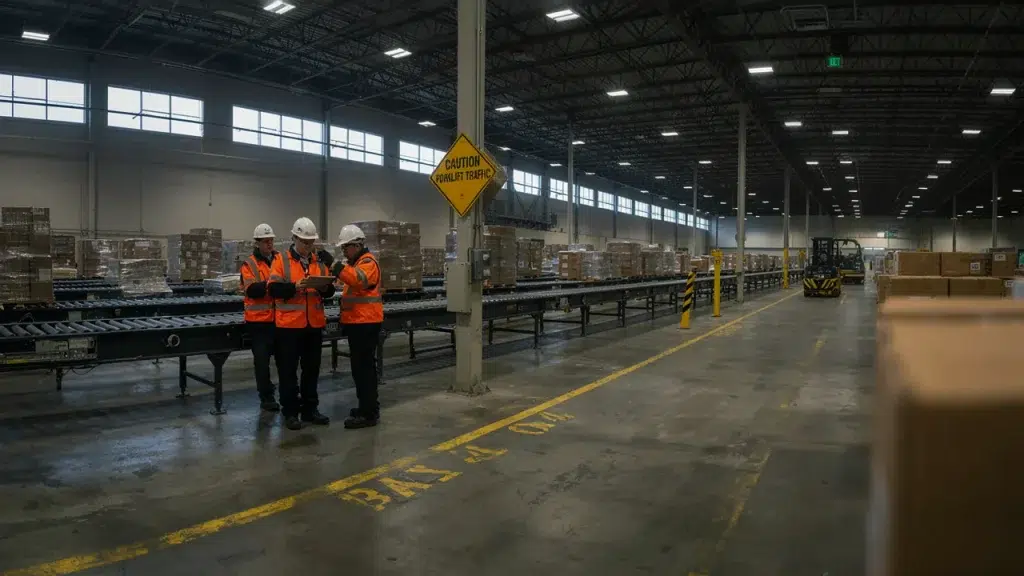
Nowhere in the country moves more freight than Chicagoland. That’s the backdrop for any warehouse wifi chicago project, and it’s why the networks here get tested harder than almost anywhere else. Distribution centers along the I-55 and I-80 corridors keep getting bigger, and the WiFi that came with the building rarely keeps up.
Here’s the short version. A consumer router might cover a small office. Drop that same gear into a 400,000-square-foot facility full of steel racking and forklifts, though, and it falls apart within an aisle or two. This guide walks through what actually works instead.
Why Chicagoland Leads U.S. Industrial Real Estate
Chicago sits where the country’s rail, road, and air freight all cross. That location made it the biggest industrial real-estate market in the U.S., and the demand hasn’t slowed.
Scale That’s Hard to Picture: Facilities along the corridors routinely run past 300,000 square feet under one roof. At that size, an industrial network installation chicago project isn’t a handful of access points. It’s dozens, all designed to work as one system.
Winter Is a Real Factor: Hard freezes and heavy snow are part of the deal here. Outdoor gear and rooftop cable runs need weather-rated hardware, and the smart move is scheduling that work before the first deep freeze hits.
Common WiFi Problems in Chicago Distribution Centers
Walk enough of these buildings and the same complaints come up again and again. Almost always, they point back to a network nobody redesigned as the facility grew.
Dead Zones in High-Bay Storage: Tall racking blocks signal between aisles. Coverage that looked fine on an empty floor plan disappears the moment product fills the shelves.
RF Interference from Equipment: Conveyor motors, forklift chargers, high-bay lighting — they all throw off RF noise. Consumer gear can’t filter it out, so the signal degrades even when the access points sit exactly where they should.
Roaming Failures on the Floor: Scanners and forklift tablets never stop moving. If the access points aren’t tuned to hand devices off cleanly, workers get a dropped connection every time they cross from one coverage zone to the next.
Warehouse Network Design Chicago Facilities Require
High ceilings and dense racking change everything about the design. A warehouse network design chicago operators can trust looks nothing like an office build, and treating it like one is where most installs go wrong.
Ceiling Height Drives Antenna Choice: An access point 30 feet up needs a different antenna pattern than one at 10 feet. Get that wrong and the signal never really reaches the floor, no matter how many units you hang.
Long Aisles Want Direction: Some of these buildings have aisle runs stretching several hundred feet. In those cases, directional antennas usually beat standard omnidirectional ones by a wide margin.
Want the deeper technical version? Our warehouse wireless networking guide lays out the fundamentals.
Supporting Scanners, Forklifts & Freight Systems
A distribution center wifi illinois teams depend on runs far more than email and web traffic. It runs the systems that keep freight moving out the door.
Handheld Scanners: For scanning, low latency beats raw speed every time. Half a second of hesitation per scan sounds trivial, but multiply it across thousands of scans a shift and it turns into real lost hours.
Forklift-Mounted Tablets: These move all day. They need clean roaming across the whole building, not just strong signal near the office.
Freight Facility WiFi: Then there’s everything outside the four walls. A freight facility wifi network has to reach loading docks, rail sidings, and the yard, which means outdoor-rated coverage matters just as much as what’s inside.
Why a Warehouse WiFi Site Survey Matters
In a building this big, guessing at placement simply doesn’t work. A site survey shows how signal behaves in your actual space, which is the only thing that matters once product is on the shelves.
No Two Buildings Match: Cold storage behaves nothing like dry goods. Racking height, wall material, equipment density — each one shifts the design, so the survey is where a real plan starts.
Skipping It Costs More Later: Design without a survey and you’ll likely be paying for rework once the gaps show up. Catching them upfront is always cheaper.
Curious what a project like this runs? Our Chicago installation cost guide breaks down warehouse-scale pricing.
How UniFi Nerds Supports Chicago Warehouses
We’ve built networks for distribution centers and industrial facilities all over Chicagoland, and we bring the same playbook we use for warehouse clients nationwide.
How We Work: It always starts with a survey — never a guess based on square footage. From there we build the design around your racking, your ceiling height, and the mix of devices on your floor. Our Chicago UniFi installation team takes it from that first walkthrough all the way through testing.
Already have a network that’s fighting dead zones? Our Chicago UniFi support team can audit it and fix what’s broken. We’ve solved the same problems in other freight hubs too, as our Atlanta and Dallas warehouse guides show.
Frequently Asked Questions About Chicago Warehouse WiFi
What makes warehouse WiFi different from a standard office network?
Taller ceilings, denser building materials, and devices that never sit still. An office network is built around fixed desks and a fraction of the square footage, so the two really aren’t comparable.
Can UniFi handle a 500,000-square-foot distribution center?
It can, as long as the access point count and design come from a real survey. A facility that size usually needs dozens of units working together.
Does Chicago winter weather affect a warehouse install?
Mostly for outdoor equipment and rooftop cable runs. A lot of facilities schedule that exterior work for warmer months and keep the indoor build going year-round.
How much does warehouse WiFi cost in Chicago?
Square footage and access point count drive most of it. Our Chicago installation cost guide walks through warehouse-scale pricing in detail.
How long does a warehouse site survey take?
A large facility usually takes a full day or more, depending on how complex the layout is. Multi-building campuses run longer, since every structure needs its own look.
Final Thoughts on Warehouse WiFi in Chicago
Here’s what it comes down to. In the biggest industrial market in the country, the network can’t be an afterthought bolted on once the racking’s already up. The buildings are enormous, the freight never stops, and every dropped scan slows the whole operation down.
If your warehouse wifi chicago setup keeps leaving dead spots or dropping devices mid-aisle, don’t add another router and hope. Start with a survey, and build from what the building actually tells you.
Ready to Book a Warehouse WiFi Site Survey in Chicago?
We’ll walk your facility, map coverage against your racking, ceiling height, and equipment layout, and scope the right access points and cabling for a clean, tested warehouse network.
Call: 833-469-6373 or 516-606-3774
Text: 516-606-3774 or 772-200-2600
Email: hello@unifinerds.com | Visit: unifinerds.com
Free consultations • Phased implementation • Budget-friendly • Expert support