
Cold Storage & Food Distribution WiFi: Networking Freezer Warehouses in KC, Chicago & Beyond
Try mounting a standard access point inside a -10°F freezer and see how long it lasts. It won’t. The electronics seize, condensation forms the second a door opens, and the whole thing dies before the first inventory count. That’s the brutal reality behind cold storage warehouse wifi, and it’s a problem most installers have never actually solved.
Kansas City is a national food-logistics hub. Chicago moves freight like nowhere else. Across the Midwest, refrigerated and frozen warehouses keep growing, and every one of them needs scanners, sensors, and cameras working in temperatures that would kill consumer gear. This guide covers how it’s done right.
Why Freezers Destroy Standard Networks
A freezer warehouse is one of the harshest places on earth to run a network. Cold, moisture, and temperature swings all attack the equipment at once.
Electronics Hate the Cold: Most access points are rated to roughly 32°F at the low end. Because a blast freezer runs far below that, standard gear simply stops working, sometimes within hours.
Condensation Is the Silent Killer: Every time a dock door opens, warm humid air meets frozen surfaces. As a result, condensation forms on and inside equipment, and that moisture corrodes electronics fast.
Sub-Zero Access Point Enclosures
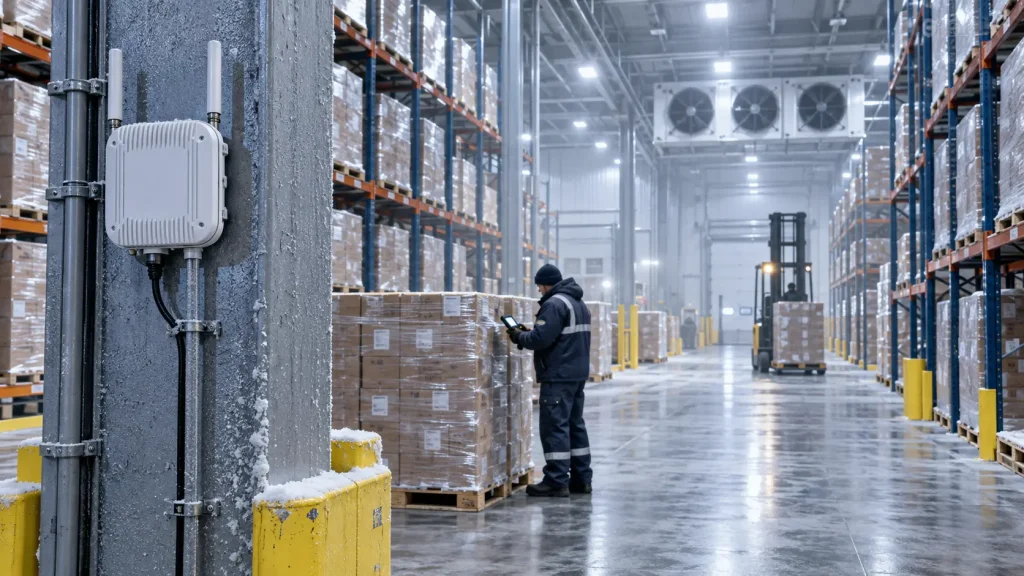
The core of any freezer install is protecting the hardware. A sub zero access point enclosure is what keeps a normal AP alive in an abnormal environment.
Heated, Sealed Housings: Specialized enclosures wrap the access point in a heated, sealed shell that holds the electronics in their safe operating range. Therefore, the AP itself never actually experiences the freezer’s true temperature.
Condensation Control: A proper enclosure also manages moisture, so warm air rushing in during a door cycle doesn’t fog or corrode the gear. Because of that sealing, the equipment survives the daily temperature swings that would otherwise destroy it.
Our environmental factors guide digs into how temperature, humidity, and building conditions shape a warehouse network design.
Signal & Interference in a Freezer Warehouse Network
Cold is only half the battle. A freezer warehouse network also fights signal problems that a dry warehouse never sees.
Metal and Ice Everywhere: Steel racking, metal walls, and layers of frost all reflect and absorb WiFi signal. As a result, coverage that works in a dry-goods warehouse falls apart between frozen aisles without careful planning.
Refrigeration Equipment Noise: Compressors, fans, and defrost cycles all generate RF interference. Our RF interference guide covers how we find that noise and design around it.
Scanner Roaming Across Cold and Ambient Zones
Food distribution facilities rarely have just one temperature. A single building might hold a freezer, a cooler, and an ambient dock, and a forklift crosses all three in a shift.
Seamless Handoffs Between Zones: Scanners and forklift tablets need to roam cleanly as they move from the frozen aisle to the loading dock. Otherwise, a dropped connection at every zone boundary slows the whole operation.
Cold Doesn’t Wait: Product can’t sit on a warm dock while someone reconnects a scanner. So reliable, continuous coverage across every temperature zone directly protects the cold chain and the inventory.
Food Distribution Facility WiFi & Compliance Tech
A food distribution facility wifi network carries more than scanners. It also runs the monitoring and compliance systems the business depends on.
Temperature Monitoring Sensors: Refrigerated warehouse technology increasingly relies on wireless sensors tracking temperature across every zone. Because those readings feed food-safety records, the network behind them has to stay up.
Cameras and Security: Cold-storage facilities run cameras for safety and loss prevention, and those need cold-rated housings too. Meanwhile, the same network carries those feeds back to a central recorder.
How UniFi Nerds Handles Cold-Storage Networks
We work with cold-storage and food-distribution facilities across the Midwest, from Kansas City’s food-logistics corridor to Chicago and beyond. Freezer environments are a specialty, not an afterthought.
How We Approach It: First, we survey every zone — freezer, cooler, and ambient — and map the temperature transitions. From there, we spec heated enclosures, cold-rated cameras, and roaming built for the way crews actually move product.
Our Kansas City UniFi installation, Chicago installation, and Indianapolis installation teams all handle warehouse-scale builds. For the broader industrial playbook, our warehouse wireless networking guide and Chicago warehouse guide go deeper.
Frequently Asked Questions About Cold Storage Warehouse WiFi
Can a normal access point work inside a freezer?
No. Most access points are rated only to around freezing, so a blast freezer runs far below their limit. They need a heated, sealed enclosure to survive.
What’s the biggest threat to equipment in cold storage?
Condensation, honestly. Every time warm air meets frozen surfaces, moisture forms and corrodes electronics, which is why sealed enclosures matter so much.
How do scanners stay connected across different temperature zones?
Through seamless roaming. A properly designed network hands devices off cleanly as they move from freezer to cooler to ambient dock, without dropping the connection.
Does refrigeration equipment interfere with WiFi?
It can. Compressors, fans, and defrost cycles generate RF noise, so a site survey identifies that interference and the design works around it.
Can you support wireless temperature-monitoring sensors?
Yes. Those sensors ride on the same network, and because their readings feed food-safety records, we build in the reliability those compliance systems require.
Final Thoughts on Cold-Storage Networking
Cold storage punishes shortcuts. A network thrown together with standard gear won’t survive the first hard freeze cycle, and when it fails, the cold chain and the compliance records fail with it. That’s why cold storage warehouse wifi is a specialty, not a standard install.
Get the enclosures, the roaming, and the zone-by-zone design right, and the network disappears into the background — exactly where it belongs while your crews keep product moving.
Ready to Book a Cold-Storage Site Survey?
We’ll walk every temperature zone in your facility, spec heated enclosures and cold-rated gear, and design roaming and monitoring built to survive the freezer.
Call: 833-469-6373 or 516-606-3774
Text: 516-606-3774 or 772-200-2600
Email: hello@unifinerds.com | Visit: unifinerds.com
Free consultations • Phased implementation • Budget-friendly • Expert support