

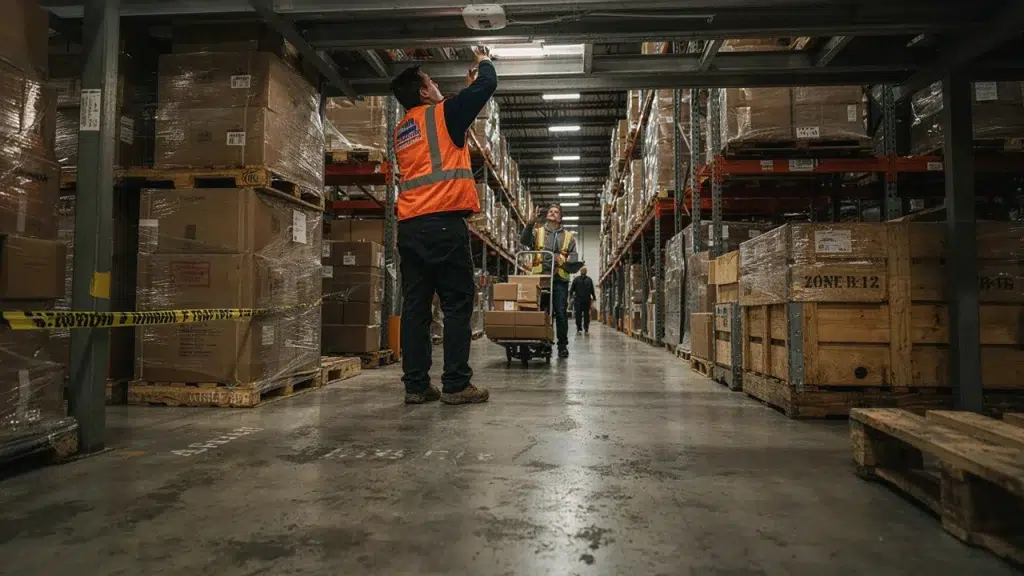
Warehouse wifi indianapolis operators need has to cover serious ground. After all, the I-70 corridor moves a huge share of America’s freight. And Indianapolis sits right at its heart, alongside Columbus and Kansas City as major distribution hubs.
A network that works fine in a small office fails fast in a facility this size. Because of high-bay racking, forklifts, and hundreds of scanners, these buildings demand a network built for them. So this guide covers what a real Midwest distribution center network needs.
Why the I-70 Corridor Is a Warehouse Powerhouse
The Midwest sits within a day’s drive of most of the U.S. population. As a result, Indianapolis, Columbus, and Kansas City have become natural distribution hubs for national logistics operations.
Scale Demands Real Coverage: A single distribution center might run 500,000 square feet or more. Consequently, industrial wifi midwest facilities need dozens of access points working together, not a handful scattered around.
Freezing Winters Affect Outdoor Gear: Unlike warmer markets, the Midwest deals with hard winter freezes. Therefore, outdoor equipment and rooftop cable runs need weather-rated hardware and careful seasonal scheduling.
Common WiFi Problems in Midwest Distribution Centers
Most facilities we walk into share the same handful of problems. Usually, they trace back to a network that was never designed for the building’s current size or use.
Dead Zones in High-Bay Storage: Tall racking blocks signal between aisles. So coverage that looks fine on a floor plan often fails once product fills the shelves.
RF Interference from Equipment: Conveyor motors, forklift chargers, and industrial lighting all generate RF noise. As a result, that noise degrades signal quality even when access point placement looks correct on paper.
Roaming Failures on the Floor: Scanners and forklift tablets move constantly through a huge facility. Without proper configuration, therefore, devices drop connection every time they cross a coverage boundary.
Distribution Center Network Columbus Ohio Facilities Rely On
A distribution center network columbus ohio operations depend on has to handle high ceilings and dense racking. Because of that, the design differs from a standard office build.
Ceiling Height Changes Antenna Choice: Access points mounted 30 feet up need different antenna patterns than ones mounted at 10 feet. Otherwise, weak signal reaches the floor even with plenty of access points installed.
Long Aisle Runs Need Directional Coverage: Some Columbus-area buildings run aisles several hundred feet long. In those layouts, directional antennas often outperform standard omnidirectional models.
Our Columbus UniFi installation team designs around each facility’s specific layout.
Supporting Scanners, Forklifts & Automation
A warehouse network kansas city operators run carries more than basic internet traffic. In fact, it runs the systems that keep product moving.
Handheld Scanners: Low latency matters more than raw speed for scanning. Because a network that hesitates even half a second per scan adds up fast across thousands of daily scans.
Forklift-Mounted Tablets: These devices move constantly. Therefore, they need reliable roaming across the entire facility, not just near the office or shipping area.
Automation Systems: Midwest facilities increasingly run automated sorting and conveyor systems. As a result, these need their own segmented, reliable network path separate from general WiFi traffic.
Why a Warehouse WiFi Site Survey Matters
Guessing at access point placement doesn’t work in a building this size. Instead, a proper site survey maps how signal actually behaves in your specific space.
Every Building Is Different: A cold storage facility behaves nothing like a dry goods warehouse. Because racking height, wall material, and equipment density all change the design.
Skipping It Gets Expensive: A network designed without a survey often needs costly rework once product fills the shelves. So a site survey catches those gaps before installation, not after.
For a broader look at warehouse networking, our warehouse wireless networking guide covers the fundamentals in depth.
How UniFi Nerds Supports Midwest Warehouses
We work with distribution centers across Indianapolis, Columbus, and Kansas City. Moreover, we bring the same approach we use for warehouse clients nationwide.
Our Process: First, every project starts with a real site survey, not a square-footage estimate. Then we design a network around your racking, ceiling height, and device mix. Our Indianapolis UniFi installation and Kansas City UniFi installation teams both handle warehouse-scale builds.
If you already have a network struggling with dead zones, our support teams can help. For instance, our Indianapolis support, Columbus support, and Kansas City support teams cover the region. We’ve also done this in other major markets, as our Atlanta and Dallas warehouse guides show.
Frequently Asked Questions About Midwest Warehouse WiFi
What makes warehouse WiFi different from a standard office network?
Warehouses have taller ceilings, denser building materials, and constantly moving devices. In contrast, office networks are designed for fixed desks and much smaller square footage.
Can UniFi handle a 500,000-square-foot distribution center?
Yes, with the right number of access points and a design based on an actual site survey. Typically, facilities this size need dozens of access points working together.
Does Midwest winter weather affect warehouse network installation?
It can, especially for outdoor equipment and rooftop cable runs. Therefore, many facilities schedule exterior work for warmer months and handle indoor work year-round.
How long does a warehouse WiFi site survey take for a large facility?
Large facilities typically take a full day or more, depending on square footage and layout complexity. Meanwhile, multi-building campuses take longer, since each structure needs its own assessment.
Do scanners and forklift tablets need special network configuration?
Yes. Because these devices move constantly, they need seamless roaming between access points to avoid dropped connections across the floor.
Final Thoughts on Warehouse WiFi in the Midwest
Warehouse wifi indianapolis, Columbus, and Kansas City facilities need has to match the scale of the region. Because the I-70 corridor moves so much freight, these buildings demand a network designed around real racking, real device density, and real winter conditions.
If your Midwest facility deals with dead zones, roaming failures, or a network that’s outgrown what it was built for, a proper site survey is the place to start.
Ready to Book a Warehouse WiFi Site Survey in the Midwest?
We’ll walk your facility, map coverage against your racking, ceiling height, and equipment layout, and scope the right access points and cabling for a clean, tested warehouse network.
Call: 833-469-6373 or 516-606-3774
Text: 516-606-3774 or 772-200-2600
Email: hello@unifinerds.com | Visit: unifinerds.com
Free consultations • Phased implementation • Budget-friendly • Expert support