

Our Nationwide UniFi Install Process: Survey, Design, Cabling, Cutover, Support
A hotel group in South Florida called us after a previous contractor handed over a completed network that nobody had tested. Three floors had dead zones. The IP camera VLANs shared the same segment as guest WiFi. The IDF switch on floor two ran at 94 percent of its PoE budget with zero headroom. They needed a real UniFi installation company to assess the damage and rebuild it correctly. We’ve handled situations like this more times than we’d like.
This post covers our full UniFi installation process from the first call to handoff — the WiFi installation process we follow on every project, regardless of size. If you’re choosing a UniFi installer or planning your first deployment, this is what a professional engagement looks like from start to finish.
Why the UniFi Installation Process Determines the Outcome
Most network problems we get called in to fix trace back to a skipped step — not bad hardware.
A structured process isn’t extra overhead. It’s the difference between a network that runs cleanly for five years and one that needs a revisit in three months. Every phase produces a deliverable: a document, a test result, a client sign-off. That’s how you build a system you can support, expand, and hand off to someone else.
Here’s exactly how we run it.
The Five Phases of Our UniFi Installation Company Process
Every deployment we run — from a 10-seat office in Long Island to a 200-room hotel in Miami — follows the same five phases. The scope changes. The process doesn’t. That consistency is why our UniFi installer team can handle projects nationwide and deliver the same quality every time.
Phase 1: Site Survey
In a Manhattan high-rise or a South Florida condo complex, the 5GHz band may already be congested before you install a single AP. That data shapes our channel planning and helps us decide whether a U7 Pro with a 6GHz radio makes more sense than a U6 Pro for a given floor.
The site survey produces a written report: floor plan annotations, existing infrastructure notes, cable run measurements, and a preliminary AP placement map. You review and approve that before we start any design work.
See our detailed guide on why every business needs a wireless site survey before installation for a full breakdown of what the survey covers and why it shapes every design decision that follows.
Phase 2: UniFi Network Design
The site survey feeds directly into the UniFi network design. This is a written specification — not a conversation or a verbal estimate. It covers every decision the installation team needs to make before work starts.
A complete design document includes AP model selection and ceiling placement coordinates per floor, switch model and PoE budget calculations for each IDF, VLAN architecture for data, voice, cameras, IoT, and guest traffic with SSID mapping, uplink topology and 10GbE interconnect plan, controller placement, and a full cable schedule with run IDs, lengths, patch panel assignments, and termination standards.
This document drives the cabling crew on install day. It also becomes your as-built record after completion. If you ever need to expand the network or bring in a new IT team, that design document is their starting point.
The South Florida hotel we mentioned had none of this. Their previous contractor installed from memory, with no documentation. That’s a direct line to the three floors of dead zones we found when we arrived.
Phase 3: Structured Cabling
Cabling is the part most clients underestimate. It’s also the most expensive part to redo. We run Cat6A as the default on all new installations. Cat6A supports 10-gigabit throughput up to 100 meters, handles the higher frequencies that WiFi 7 hardware pushes through the cable plant, and it works with every device you’re connecting today and most of what you’ll connect in the next decade.
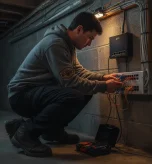
Every run gets terminated to TIA-568 standards, labeled at both ends against the cable schedule, and certified with a Fluke DSX-600 before the ceiling tile goes back up. We don’t use a basic continuity tester and call it done. Full Fluke certification gives you a pass/fail record for every run — which matters for warranty coverage and for diagnosing issues three years later without re-testing everything.
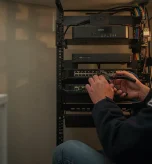
Cables dress cleanly in the IDF rack. Nothing gets zip-tied to a conduit and left loose. Visible runs go in conduit. Above-ceiling runs get secured to the structure at code-compliant intervals. For more on why certification matters long after the install date, see our breakdown of the 15-year ROI of certified structured cabling. And if you’re deciding between Cat6 and Cat6A for a new build, our Cat6 vs Cat6A vs Cat7 certification guide lays out the differences clearly.
Phase 4: Configuration and Cutover
We pre-stage hardware before cutover day — not during it. The switches, controller, and APs get bench-configured in advance. VLANs are built, SSIDs are created, firewall rules are written, and the controller is ready before anything goes in the rack. Cutover day then focuses on connecting, powering on, and validating — not debugging a live configuration in front of your staff.
On the day itself, the sequence runs like this: rack the hardware, connect the Cat6A runs, power on in stages, check PoE budgets per switch, confirm AP adoption and radio channel assignment in the controller, run a full WiFi heat map against the design coverage plan, and test every VLAN by connecting a device to each segment and confirming correct routing and isolation.
We stay on site until every VLAN passes, every AP shows green in the UniFi Network dashboard, and the PoE consumption display matches expected per-port draw. Anything that doesn’t match the design gets fixed before we leave — not logged as a follow-up item.
Phase 5: Handoff and Ongoing Support
Handoff covers three things: the as-built documentation package, a live walkthrough of the UniFi Network controller with whoever manages your infrastructure, and a 30-day check-in call to catch anything that only surfaces under real production load.
After that, our support options are flexible. Some clients have internal IT teams and only need us for firmware reviews or major configuration changes. Others want full ongoing management — remote monitoring, automated alerts, scheduled firmware updates, and a direct line to our team when something looks wrong. Our managed UniFi services page covers every tier and what’s included.
Mistakes We See All the Time
Mistake: Hiring a general IT contractor instead of a UniFi installation company with documented Ubiquiti experience.
Why it happens: General contractors often cost less to quote and already have a relationship with the client. The problem is that UniFi’s controller-based architecture, PoE management, and VLAN model differ from the Cisco and Meraki environments most general IT teams know. Those assumptions carry over — and they cause problems.
How to avoid it: Ask for three completed UniFi deployments of similar scope with as-built documentation before you sign. If a contractor quotes you without scheduling a site survey first, that tells you everything you need to know.
Mistake: Treating the UniFi installation as a one-time project with no firmware or configuration management plan afterward.
Why it happens: Once the network runs, it stops getting attention until something breaks. Ubiquiti releases firmware regularly — some updates carry security patches that matter. Running an unmanaged install for 18 months creates exposures nobody planned for.
How to avoid it: Set a quarterly firmware review on your IT calendar, or hand it to a managed service provider. It’s a 30-minute task that keeps your installation current and your security posture clean.
From the Field: On a 14-floor commercial office building in Midtown Manhattan, our team ran 340 Cat6A drops across six IDF closets. Each IDF got a USW-Pro-48-PoE switch, with fiber uplinks connecting each closet back to a USW-Aggregation in the MDF. We pre-staged all six switches before going on site. That cut the physical installation and cutover from a projected five days down to two. The client’s IT team had live traffic visibility in the UniFi controller before 4 PM on day two — because the design work happened before anyone touched a cable.
What to Ask Any UniFi Installation Company Before You Sign
- Ask to see a sample site survey report before you hire. If they can’t produce one, the survey probably isn’t a documented deliverable — it’s a walkthrough that exists only in someone’s memory.
- Confirm that cabling runs will receive full Fluke DSX certification — not just a continuity test. Certification gives you a warrant-eligible, run-by-run pass/fail record that a continuity tester simply can’t produce.
- Ask how VLAN segmentation handles cameras and guest WiFi specifically. “We’ll put everything on the same network for now” is both a security risk and a bandwidth problem. Get a straight answer before work starts.
- Make sure as-built documentation is in the contract scope. If it isn’t written into the agreement before installation, there’s a real chance it won’t exist when you need it for an expansion or a new hire two years later.
How to Evaluate a UniFi Installation Company: Five Direct Questions
Not every contractor who lists “UniFi” on their website has run a commercial deployment of real scope. These five questions cut through the noise quickly — and we’d expect any client to ask them of us, too.
Do you provide a written UniFi network design document before work begins?
A yes with a sample document is the right answer. A verbal description of what they plan to do is not a design — it’s a conversation.
What cabling standard do you install and certify to?
The answer should name TIA-568 and include Fluke DSX certification as a project deliverable — not a basic pass/fail continuity test.
How do you run the cutover without disrupting business operations?
Pre-staging and a phased cutover plan are the right answers. “We’ll do it over a weekend” with no pre-staged hardware is a plan that relies on things going right the first time.
What does post-installation support look like?
A professional UniFi installation company defines its support offering clearly — response times, scope, and pricing. “Call us if something breaks” isn’t a support plan.
Can you show me as-built documentation from a project of similar scope?
Any installer with real commercial experience can produce a redacted example. If they can’t, that gap is worth taking seriously before you sign a contract.
People Also Ask About UniFi Installation
How long does a professional UniFi installation take?
A single-floor office deployment typically takes one to two days for cabling and one day for configuration and cutover. Larger multi-floor or multi-building projects run three to five days on site, depending on port count, AP placement complexity, and how much existing infrastructure the team can reuse. Our UniFi installation company gives clients a firm timeline after the site survey — the building layout determines the schedule more than the device count does.
What does a UniFi network design include?
A complete UniFi network design covers AP model selection and placement by floor, switch sizing with PoE budget calculations, VLAN architecture for data, voice, cameras, and guest traffic, uplink topology, controller placement, and a full cable schedule. It’s a written document — not a verbal plan — that any installer can execute from and any IT team can reference later.
Do you run UniFi installations outside of New York?
Yes. Our UniFi installation company works nationwide. We’ve completed projects in New York, New Jersey, Florida, Texas, California, and across the country. For larger deployments, we build travel and scheduling into the project scope upfront. Reach out with your location and we’ll confirm availability and walk you through the timeline.
What does post-installation UniFi support include?
Post-installation support covers remote monitoring, firmware management, configuration changes, VLAN additions, user access management, and troubleshooting. We offer one-time support for clients with internal IT teams and fully managed service agreements for businesses that want ongoing oversight without adding headcount.
What a Responsible UniFi Installation Company Delivers
Every phase of a professional UniFi installation produces something you can hold an installer to: a site survey report, a written network design, a cable certification record, a validated cutover, and a defined support plan. If any of those deliverables are missing from a quote you’re reviewing, that’s where the problems start.
Most of the network rebuilds our UniFi installation company takes on weren’t caused by hardware failures. They trace back to skipped steps early in the original project. The structured cabling process and the configuration work are straightforward when the design is solid from the start.
If you’re planning a new deployment or inheriting a network that was never done right, book a call. We’ll walk through your space, put a proper design on paper, and give you a scope that covers every phase — not just the day we show up with cable.
Ready to Work With a UniFi Installation Company That Documents Everything?
Tell us your location, building type, and approximate device count. We’ll scope the site survey, network design, cabling, and support so you know exactly what you’re getting before any work begins.
Call: 833-469-6373 or 516-606-3774
Text: 516-606-3774 or 772-200-2600
Email: hello@unifinerds.com | Visit: unifinerds.com
Free consultations • Phased implementation • Budget-friendly • Expert support