

Structured Cabling NYC : The Complete Guide for Offices and Commercial Spaces
If your NYC office WiFi feels unreliable, phones drop calls, or conference rooms “randomly” lose connectivity, the root cause is often not the internet provider. It is the physical layer. Strong structured cabling NYC office is what makes networks stable, scalable, and easy to support. In New York City, where buildings are dense and construction is complex, choosing the right low voltage cabling NYC approach and the right commercial cabling contractors NYC matters. This guide explains how to plan office network cabling NYC projects for performance, code compliance, and long-term growth.
This is written for hotel managers, IT teams, MSPs, and business owners who need dependable connectivity in guest rooms, lobbies, conference rooms, restaurants, offices, and even outdoor areas.
What structured cabling is (and why NYC businesses need it)
Structured cabling is a standardized way to build your network wiring so it is organized, labeled, and designed for long-term use. Therefore, instead of “random cables everywhere,” you get a system that supports moves, adds, and changes without chaos.
What structured cabling typically includes
- Horizontal cabling: runs from the telecom room to desks, APs, cameras, and phones
- Backbone cabling: connections between floors (often fiber)
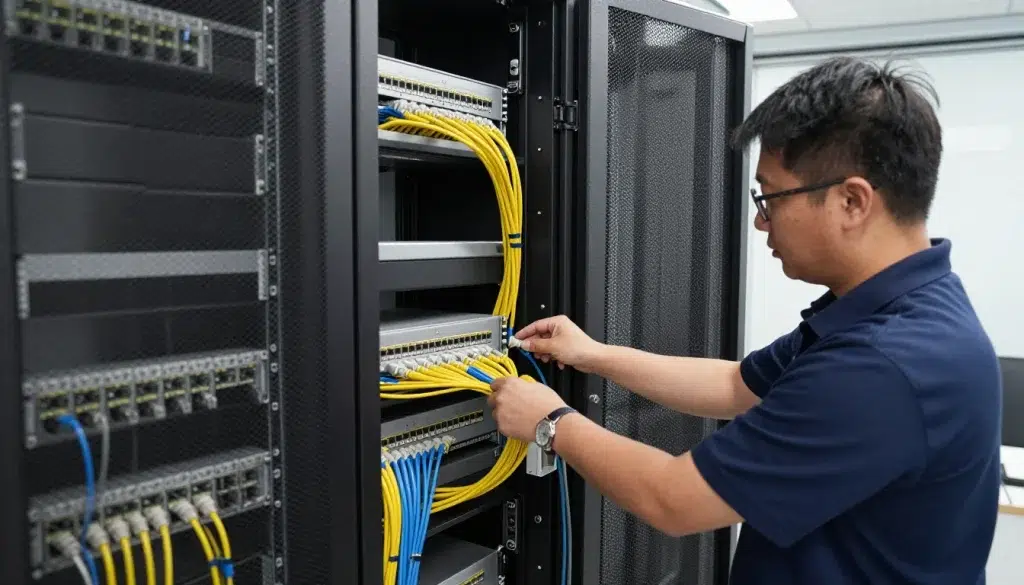
- Patch panels and racks: clean termination and organization
- Telecom rooms (MDF/IDF): where switches and core equipment live
- Labeling and documentation: so troubleshooting is fast and accurate
Real-world scenario: A Manhattan office adds more staff and installs new WiFi access points. However, the network still drops in conference rooms. The issue is not the APs. The existing cabling is a mix of old runs, unlabeled terminations, and poor patching. After a structured cabling refresh with proper labeling and testing, outages drop and support becomes predictable.
Expert Insight: In NYC, the biggest cabling cost is not cable. It is labor, access, and routing. That is why “doing it right once” is cheaper than repeated patchwork fixes that disrupt tenants and operations.
Where structured cabling is used in NYC commercial spaces
Structured cabling supports far more than desktops. In addition, modern buildings have more connected devices than ever.
Common endpoints for office network cabling NYC projects
- WiFi access points (PoE-powered)
- VoIP phones and conference room systems
- Security cameras and access control panels
- POS systems in restaurants and hospitality spaces
- Printers, workstations, and docking stations
- Digital signage and TVs
- IoT devices (sensors, controllers, building systems)
Step-by-step: how to plan a structured cabling NYC office project
A good cabling project starts with planning. Therefore, you avoid change orders, delays, and messy installs.
Step 1: Define the scope and growth plan
- How many workstations today, and how many in 12–36 months?
- How many WiFi APs, cameras, phones, and conference rooms?
- Do you need multi-floor backbone links?
- Will you add more locations or tenants later?
Step 2: Choose the right cable types (Cat6, Cat6A, fiber)
Most NYC offices use copper for endpoints and fiber for backbone. However, the right choice depends on speed, distance, and environment.
- Cat6: common for 1 Gbps and many standard office runs
- Cat6A: better for 10 Gbps readiness and higher PoE loads, with improved performance at longer distances
- Fiber optic backbone: ideal for multi-floor links, longer distances, and higher throughput
Tips: How to avoid re-cabling in 2 years
- Run extra drops in key areas (conference rooms, reception, IT closets).
- Use Cat6A for high-value runs where upgrades are likely.
- Plan fiber between floors even if you do not “need it yet.” It is cheaper during the build than later.
Step 3: Design the MDF/IDF layout (especially for multi-floor NYC buildings)
In NYC, long cable runs and limited pathways can create headaches. Therefore, placing the right telecom rooms on the right floors matters.
- MDF (Main Distribution Frame): core network gear and ISP handoff
- IDF (Intermediate Distribution Frame): floor-level switching for shorter runs
- Backbone: fiber links between MDF and IDFs
Step 4: Pathways, firestopping, and building coordination
Routing cable in NYC is often the hardest part. In addition, you may need approvals for penetrations, risers, and after-hours access.
- Confirm pathways (conduit, tray, risers, ceiling access).
- Coordinate with building management and other trades.
- Use proper firestopping for penetrations.
- Plan work windows to minimize disruption (nights, weekends, phased floors).
Step 5: Installation standards, labeling, and documentation
This is where many installs fail. However, clean termination and labeling is what makes a network supportable.
- Terminate to patch panels and keystone jacks properly.
- Label both ends of every cable consistently.
- Organize racks with cable management and service loops.
- Create a port map and as-built documentation.
Common Mistakes: What causes cabling problems in NYC offices
Skipping labeling. It saves time on day one and costs time forever after.
Over-tight cable bundles. It can damage cable performance and make future changes painful.
No plan for PoE loads. Modern APs and cameras can require higher PoE budgets and better cable quality.
Low voltage cabling NYC: what “good workmanship” looks like
Low voltage work includes network cabling, cameras, access control, and other building systems. Therefore, quality matters because small mistakes create long-term instability.
Quality indicators to look for
- Clean cable routing: supported, not draped across ceiling tiles
- Proper bend radius: especially important for Cat6A and fiber
- Correct termination: consistent pairs, no excessive untwist
- Testing results: certification or at least documented test outcomes
- Firestopping and code compliance: especially in risers and penetrations
Commercial cabling contractors NYC: how to choose the right team
Choosing commercial cabling contractors NYC is not just about price. It is about process, documentation, and accountability.
Questions to ask before you hire
- Will you provide a cable schedule and labeling standard before work starts?
- Do you test and document every run?
- How do you handle change orders and scope adjustments?
- Can you work after-hours to reduce disruption?
- Will you coordinate with building management and comply with access rules?
- Do you provide as-built documentation and a port map?
Expert Insight: The best cabling contractors reduce IT labor later. If your team can trace a port in seconds because everything is labeled and documented, you save money every time something changes.
Best practices checklist for structured cabling NYC office
- Plan for growth: extra drops, extra rack space, and future AP locations.
- Use the right mix of Cat6/Cat6A and fiber based on distance and speed goals.
- Design MDF/IDF placement to keep runs short and manageable.
- Coordinate pathways, risers, and firestopping with building requirements.
- Label everything and deliver a port map with as-built documentation.
- Test runs and keep results for troubleshooting and audits.
Industry standards and guidance to reference
- ANSI/TIA structured cabling standards:strong cabling topology, labeling, and performance expectations
- NEC (National Electrical Code): strong low voltage installation and safety considerations
- IEEE 802.3: strong Ethernet and PoE fundamentals that impact endpoint power and performance
FAQ: structured cabling NYC offices and commercial buildings
How much structured cabling do I need for an office buildout?
It depends on headcount, workstation layout, conference rooms, and device types. Many offices plan at least two drops per workstation area plus dedicated drops for APs, phones, printers, and conference rooms. Planning for growth prevents expensive rework later.
Should I choose Cat6 or Cat6A in NYC?
Cat6 is common and cost-effective for many 1 Gbps needs. Cat6A is better for 10 Gbps readiness, higher PoE loads, and performance at longer distances. If you expect upgrades or high-performance needs, Cat6A is often worth it in key areas.
When do I need fiber optic cabling?
Fiber is ideal for backbone links between floors, longer distances, and high-throughput connections. In multi-floor NYC buildings, fiber between MDF and IDFs is a best practice because it supports future growth and reduces bottlenecks.
How do I know if my cabling is causing network problems?
Common signs include intermittent drops, slow speeds on wired devices, PoE devices rebooting, and recurring “port flaps” on switches. Testing and certification can confirm whether cabling is meeting performance standards.
What deliverables should I expect from a structured cabling project?
You should receive labeled terminations, a port map, as-built documentation, and testing results. These deliverables reduce downtime and make future expansions much easier.
Conclusion: structured cabling is the foundation of reliable NYC networks
Reliable networks in NYC start with the physical layer. Strong structured cabling NYC office makes WiFi more stable, improves VoIP quality, supports cameras and access control, and simplifies troubleshooting. When you plan cable types, MDF/IDF layouts, pathways, and documentation correctly, you get a network that scales with your business instead of fighting it.
If you are upgrading an office, hotel, or commercial space, treat cabling as infrastructure, not an afterthought. It is the difference between a network that “mostly works” and one that stays reliable during peak usage.
Need Structured Cabling in NYC That’s Clean, Tested, and Built to Scale?
We’ll plan and install structured cabling for offices and commercial spaces—optimized for WiFi, VoIP, cameras, and future growth with clear labeling and documentation.
Call: 833-469-6373 or 516-606-3774
Text: 516-606-3774 or 772-200-2600
Email: hello@unifinerds.com | Visit: unifinerds.com
Free consultations • Phased implementation • Budget-friendly • Expert support