

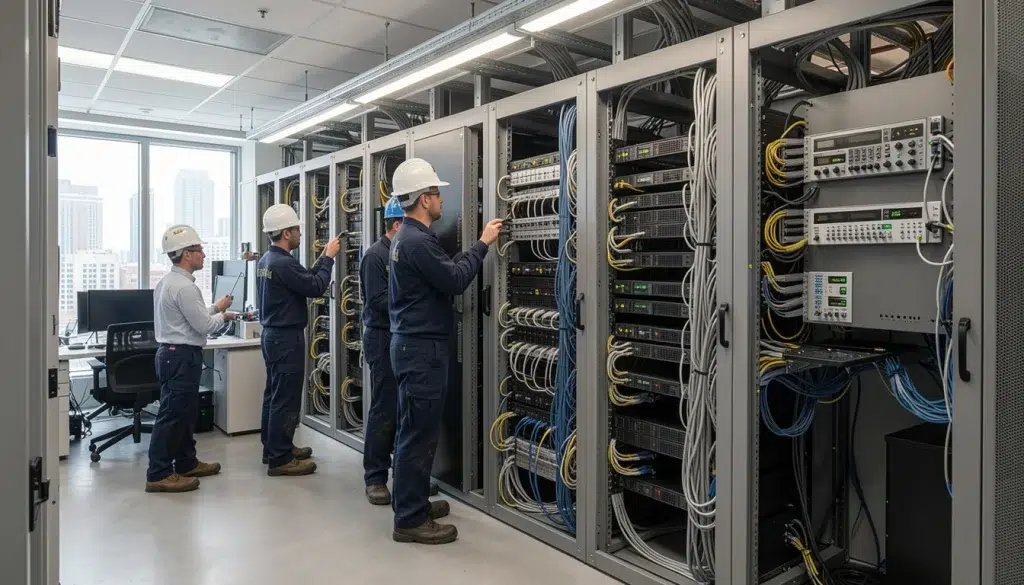
What Is Structured Cabling and Why NYC Businesses Need It
If your office WiFi feels “random,” phones drop calls, or a simple desk move turns into a half-day outage, the problem is often not your internet provider. It is your wiring. What is structured cabling? It is a standardized way to design and install network wiring so your business has reliable connectivity today and a clean path to grow later. In New York City, where buildings are dense and construction is complicated, structured cabling explained in plain terms can help you avoid expensive rework. This guide covers low voltage wiring NYC realities and business cabling basics for offices that need stable internet, VoIP, cameras, and future upgrades.
The goal is simple: fewer outages, faster troubleshooting, and infrastructure that supports your business instead of slowing it down.
What is structured cabling? (A simple definition)
Structured cabling is a planned, organized wiring system for your building. Instead of running “whatever cable fits” wherever it is convenient, structured cabling uses a standard layout with labeled runs, patch panels, racks, and telecom rooms. Therefore, your network becomes easier to maintain and expand.
What structured cabling usually includes
- Telecom rooms (MDF/IDF): where network switches and core equipment live
- Patch panels: organized termination points for network runs
- Horizontal cabling: runs to desks, WiFi access points, phones, and cameras
- Backbone cabling: connections between floors (often fiber)
- Labeling and documentation: so you can trace and fix issues quickly
Real-world scenario: A NYC office adds five new employees. The IT team plugs in a few “temporary” cables and power strips. Two months later, a conference room loses connectivity and nobody knows which cable feeds it. With structured cabling, every run is labeled and mapped, so fixes take minutes, not hours.
Expert Insight: In NYC, the biggest cost is not the cable. It is access, routing, and labor. That is why a clean, documented structured cabling install is usually cheaper long-term than repeated patchwork changes that disrupt staff and tenants.
Structured cabling explained: why it matters for NYC businesses
NYC businesses rely on connectivity for everything: cloud apps, phones, payments, security, and collaboration. However, many offices still run on wiring that was never designed for modern usage. Therefore, performance becomes unpredictable.
What structured cabling supports in a modern office
- Fast internet and stable LAN performance: fewer drops and less “mystery slowness”
- VoIP phone systems: clearer calls and fewer jitter-related issues
- WiFi access points: reliable wired backhaul and PoE power
- Security cameras: clean PoE runs and predictable video performance
- Conference rooms: stable video calls and screen sharing
- Future growth: easier expansions, moves, and upgrades
Low voltage wiring NYC: what makes it tricky
Low voltage wiring NYC projects are rarely “simple.” In addition to the technical work, you have building rules, limited pathways, and scheduling constraints.
Common NYC constraints that impact cabling
- Limited riser and conduit access: especially in older buildings
- Concrete, brick, and fire-rated barriers: harder routing and stricter compliance
- After-hours requirements: many offices need nights or weekends
- Shared ceilings and mixed tenants: coordination is critical
- Firestopping requirements: penetrations must be sealed correctly
Real-world scenario: A company moves into a Midtown office and assumes they can “just run a few lines.” The building requires approvals for ceiling access and penetrations, and the riser is shared. A structured plan prevents delays and change orders by mapping pathways and scheduling access before work begins.
Business cabling basics: the parts you should understand before you hire anyone
You do not need to be an engineer to make good decisions. However, knowing the basics helps you avoid bad installs and vague proposals.
Copper vs fiber: what’s the difference?
- Copper (Cat6/Cat6A): common for desks, phones, cameras, and WiFi access points
- Fiber: common for backbone links between floors and high-throughput connections
Cat6 vs Cat6A (a practical view)
- Cat6: cost-effective for many office endpoints and standard runs
- Cat6A: better for 10G readiness, higher PoE loads, and stronger performance margins
PoE (Power over Ethernet) matters more than most people think
PoE lets network cables power devices like WiFi access points, phones, and cameras. Therefore, your cabling and switches must be planned for power budgets, not just data.
Tips: How to plan structured cabling for future growth
- Add extra drops in conference rooms, reception, and shared spaces (growth always happens there).
- Plan dedicated drops for every WiFi access point and camera (avoid “splitters” and shortcuts).
- Consider fiber between floors even if you do not need it today. It is cheaper during the buildout.
What “good” structured cabling looks like in the real world
A good cabling job is obvious when you open the rack. In addition, it shows up later when troubleshooting is fast.
Quality indicators to look for
- Clean rack layout: patch panels, cable management, and service loops
- Consistent labeling: both ends of every run labeled clearly
- Documented port map: you know what every port feeds
- Proper bend radius: especially for Cat6A and fiber
- Testing results: at least verification, ideally certification where appropriate
- Firestopping and compliance: penetrations sealed properly
Common Mistakes: Why structured cabling projects go wrong
Skipping labeling and documentation. It saves time on day one and costs time forever after.
Using “temporary” cabling as permanent infrastructure. It becomes fragile and hard to support.
Not planning for PoE. APs and cameras may reboot or underperform if power and cabling quality are not sized correctly.
Step-by-step: how NYC businesses should approach a structured cabling project
Structured cabling is a process. Therefore, you get better results when the scope and standards are defined before the first cable is pulled.
Walk the space and map endpoints
- Count desks, conference rooms, printers, and shared devices.
- Identify WiFi access point locations and camera locations.
- Plan network closet locations (MDF/IDF) for multi-floor spaces.
Choose cable types and backbone strategy
- Decide where Cat6 vs Cat6A makes sense.
- Plan fiber for floor-to-floor or long-distance links.
- Confirm pathways and building requirements early.
Define standards (labeling, testing, and deliverables)
- Labeling format (example: FL12-CR1-A-07).
- Testing expectations and documentation format.
- As-built drawings and port maps.
Install, test, and document
- Terminate cleanly to patch panels and keystones.
- Test runs and fix issues before go-live.
- Deliver documentation that your IT team can actually use.
FAQ: structured cabling for NYC businesses
What is structured cabling in simple terms?
It is an organized wiring system for your building that uses standard layouts, patch panels, labeling, and documentation. It makes your network easier to maintain and expand.
Do I need structured cabling if I use WiFi?
Yes, in most cases. WiFi access points still need reliable wired backhaul and PoE power. In addition, critical devices like phones, cameras, and conference room systems are often best on wired connections.
How do I know if my cabling is causing problems?
Signs include intermittent drops, slow wired performance, PoE devices rebooting, and recurring switch port errors. Testing and documentation can confirm whether cabling is meeting performance expectations.
Should NYC businesses use Cat6 or Cat6A?
Cat6 is common and cost-effective for many endpoints. Cat6A is better for 10G readiness and higher PoE loads. Many businesses use a mix: Cat6A for key areas and Cat6 for standard drops.
What deliverables should I expect from a structured cabling install?
You should receive labeled terminations, a port map, as-built documentation, and testing results. These deliverables are what make the system supportable long-term.
Conclusion: structured cabling is the foundation of reliable NYC connectivity
When people ask what is structured cabling, the best answer is this: it is the foundation that makes everything else work better. Reliable WiFi, clean VoIP calls, stable camera systems, and fast troubleshooting all depend on organized, tested wiring. In NYC, where access and routing are complex, structured cabling is not a luxury. It is how you avoid downtime and build infrastructure that scales with your business.
If your office is expanding, moving, or constantly dealing with “network weirdness,” structured cabling is often the highest-return upgrade you can make.
Want Structured Cabling That’s Clean, Labeled, and Built for Growth?
We’ll help you plan and install structured cabling that supports fast internet, VoIP, WiFi access points, and cameras—without the messy wiring and future headaches.
Call: 833-469-6373 or 516-606-3774
Text: 516-606-3774 or 772-200-2600
Email: hello@unifinerds.com | Visit: unifinerds.com
Free consultations • Phased implementation • Budget-friendly • Expert support