

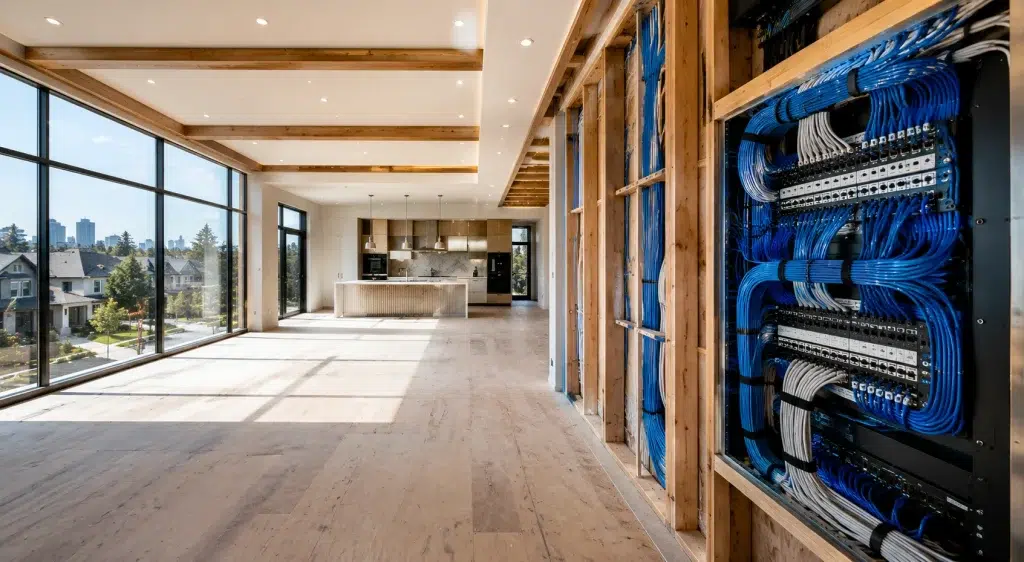
Inside a Fully Wired New Construction Home in New York
Most homeowners don’t realize what they missed until after they move in. The WiFi is “fine” in the living room, but weak upstairs. The doorbell camera lags. Video calls stutter when someone starts streaming. That’s why a new construction wired home New York plan is one of the smartest decisions you can make before drywall. When smart home wiring New York is planned correctly, structured cabling new home NY becomes the backbone for reliable WiFi, security, and future upgrades. In this walkthrough, we’ll show what a fully wired home looks like, including a practical ethernet pre-wire NY layout that builders and homeowners can actually execute.
Target audience: New York homeowners building a custom home (or doing a gut renovation), plus builders and general contractors who want a clear picture of what “fully wired” means and how to scope it correctly.
What “fully wired” really means (and what it does not)
A fully wired home is not “Ethernet in a few rooms.” It is a planned system where all low-voltage cabling is home-run to a central network closet, labeled, tested, and designed around how the home will be used. Therefore, it’s easier to support and easier to upgrade.
What you should expect in a new construction wired home New York
- A dedicated network closet or structured media area
- Cat6 Ethernet runs to key rooms and device zones
- Wired WiFi access points (not just a single router)
- PoE-ready camera wiring and doorbell wiring
- Clean terminations with patch panels and labeling
- Testing and documentation (as-built map)
However, “fully wired” does not mean overbuilding. It means wiring the right places so WiFi stays fast and the home stays supportable.
Expert Insight: The biggest difference between a frustrating smart home and a reliable one is not the brand of devices. It’s the wiring plan: access point locations, camera drops, and a clean network closet with labeled cabling.
Walkthrough: the network closet (the “heart” of the home)
In a structured cabling new home NY design, everything starts at the network closet. Therefore, this space should be planned like a real system area, not an afterthought.
What’s inside a well-built network closet
- ISP handoff: where the internet connection enters the home
- Router / gateway: manages security and traffic
- Switch: distributes network connections to the home
- Patch panel: clean termination for all Ethernet runs
- UPS (optional but recommended): keeps network stable during brief outages
- Space for growth: extra ports and room for future gear
Network closet placement tips (New York realities)
- Choose a location with ventilation (heat causes instability)
- Avoid tiny sealed boxes that can’t fit a switch and patch panel
- Keep it accessible for service (not buried behind storage)
- Plan pathways to attic/basement for clean cable routes
Tips: The “builder-friendly” network closet checklist
- Dedicated outlet and space for a UPS.
- Enough wall space for a patch panel and switch.
- Label every cable on both ends and provide an as-built map.
Walkthrough: ethernet pre-wire NY (what gets wired and why)
Ethernet is still the most reliable connection in the home. Therefore, the goal is to wire the fixed devices and the WiFi system itself. This reduces wireless congestion and makes performance predictable.
Zone 1: Living room and media walls
Media areas create more network load than most people expect. In addition, they often sit behind thick walls or fireplaces that can block WiFi.
- Two Cat6 drops behind each TV location
- One Cat6 drop near an AV cabinet or media shelf
- Optional conduit behind TVs for future cable changes
Zone 2: Home office and desk areas
Work-from-home performance is about stability, not just speed. Therefore, offices should be wired even if WiFi is strong.
- Two Cat6 drops at each desk wall (PC + dock/phone/printer)
- Optional extra drop for future expansion
Zone 3: Bedrooms
- At least one Cat6 drop per bedroom
- Add a second if a desk is likely
Zone 4: Basement and bonus spaces
Basements often become offices, gyms, or media rooms later. Therefore, wiring them early avoids expensive retrofits.
- Two Cat6 drops at TV/media locations
- One Cat6 drop for a future access point if the space is large
Zone 5: Garage and exterior
- One Cat6 drop in the garage for future camera or access point
- Cat6 drops to exterior camera locations (front, driveway, backyard)
If you want to support readers further, you can internally link using anchor text like wired home infrastructure checklist for new builds and how to plan your home’s wired infrastructure before breaking ground.
Walkthrough: smart home wiring New York (cameras, doorbells, and PoE)
Smart home devices are only as reliable as the network underneath them. Therefore, wiring cameras and access points is usually a better long-term choice than relying on WiFi for everything.
What to wire for security and smart home stability
- PoE cameras: stable power and data over one cable
- Doorbell wiring: consistent power and better reliability
- Network video recorder (if used): wired connection for recording stability
- Smart home hubs: stable backbone for automation
Real-world scenario: A homeowner installs WiFi cameras on the exterior. When the family streams video inside, the cameras lag or drop. Wired PoE cameras keep recording reliably even when WiFi is busy.
Expert Insight: If a device is security-related, “mostly works” is not good enough. Wired cameras and wired access points reduce failure points and make troubleshooting straightforward.
Walkthrough: WiFi done right (wired access points, not “one router”)
In a new construction wired home New York, WiFi is still essential. However, the best WiFi usually comes from wired access points placed intentionally. Therefore, access point wiring is one of the highest-ROI parts of the build.
Access point planning checklist
- Plan at least one access point per floor
- Add more for long layouts, dense walls, or large open areas
- Prefer ceiling or high-wall locations for better signal spread
- Run Cat6 to each access point location (home-run)
- Plan for PoE so you don’t need an outlet at the access point
For internal linking, anchor text like mesh WiFi vs wired access points fits naturally for readers deciding between approaches.
Structured cabling new home NY: quality rules that separate “clean” from “problematic”
Even the best plan can fail if the installation is sloppy. Therefore, structured cabling new home NY projects should include labeling, testing, and documentation.
Structured cabling installation best practices
- Use home-run cabling to a central location (no daisy chaining)
- Avoid tight bends, kinks, and crushed cable
- Keep separation from electrical power where practical
- Use correct terminations and pinouts
- Protect cables at studs and penetrations
Cable labeling standards (simple and professional)
- Label both ends of every cable with the same ID
- Use a consistent naming format (Floor-Room-Wall-Port)
- Provide an as-built map that matches the labels
Cable certification testing (what “tested” should mean)
- Test every run before insulation and drywall
- Test again at trim-out
- Record results and keep them with homeowner documentation
Common Mistakes: What breaks a “fully wired” home
No access point wiring. This forces mesh nodes in bad locations and creates dead zones.
Too few drops at TVs and offices. WiFi gets congested and performance feels inconsistent.
Network closet too small or too hot. Gear overheats and upgrades become messy.
No labeling or documentation. Troubleshooting becomes slow and expensive.
Skipping testing. Bad terminations show up after move-in when fixes are hardest.
Future-proofing: build pathways, not predictions
Future-proofing is not guessing what devices will exist in 10 years. It’s building flexibility. Therefore, add conduit and spare capacity where it matters.
Best practices for future-proofing a structured cabling new home NY project
- Add conduit from the network closet to attic/basement where possible
- Leave spare ports on the patch panel and switch capacity
- Run extra cable to hard-to-reach areas while walls are open
- Document everything so future upgrades are clean and non-invasive
Industry standards (quick reference)
Professional installations follow proven standards and guidance. In addition, standards help ensure consistent performance and documentation.
- IEEE 802.3: Ethernet (wired networking)
- IEEE 802.11: WiFi (wireless networking)
- ANSI/TIA structured cabling standards: cabling performance and administration guidance
FAQ: new construction wired home New York
How many Ethernet drops should a fully wired home have?
It depends on lifestyle. However, a practical baseline is two drops behind TVs and in offices, at least one per bedroom, plus access points and camera locations.
Is it worth wiring access points if I’m using a mesh system?
Yes. Wired access points (or wired mesh backhaul) usually improve stability and speed. Mesh can work, however wireless backhaul often becomes the bottleneck.
Should cameras be wired or wireless?
Wired cameras are typically more reliable and can use PoE. WiFi cameras can work, however they are more sensitive to congestion and coverage gaps.
What should I ask for from my installer before final payment?
Labeling on both ends, an as-built map, and testing. In addition, confirm access point and camera locations before drywall.
Do I need Cat6A for a new home in NY?
Not always. Cat6 is a practical baseline for most homes. Cat6A can be useful for specific long runs or higher-performance goals, but it should be planned intentionally.
Conclusion: a fully wired home is a better home to live in (and easier to support)
A fully wired new construction home in New York is not about showing off tech. It’s about reliability, clean installation, and long-term flexibility. When ethernet pre-wire NY is planned early, and smart home wiring New York is executed with labeling and testing, the home delivers stronger WiFi, smoother streaming, reliable security, and easier upgrades. Therefore, the best time to build it right is before drywall.
Want a Fully Wired New Construction Home Done Right in NY?
We’ll help you plan Ethernet drops, wired access points, and smart home wiring so your new build has clean, labeled, tested infrastructure and predictable WiFi from day one.
Call: 833-469-6373 or 516-606-3774
Text: 516-606-3774 or 772-200-2600
Email: hello@unifinerds.com | Visit: unifinerds.com
Free consultations • Phased implementation • Budget-friendly • Expert support