
How California’s Smart Home Market Is Driving Demand for Wired Infrastructure
California homeowners are buying more smart devices than ever, and they expect everything to “just work.” However, the smart home experience often breaks down for one simple reason: the home network was never designed for it. That’s why wired infrastructure California new homes is becoming a bigger priority across the state. As California smart home wiring becomes more common in new builds, builders and buyers are also asking for structured cabling California that supports reliable WiFi, cameras, home offices, and future upgrades. In addition, the push for new construction tech CA is raising the baseline for what a modern home should include before drywall.
Target audience: California homeowners building a new home, developers, and builders who want a practical explanation of why smart home demand is increasing the need for wired infrastructure and how to scope it correctly.
Why California smart homes are pushing networks to the limit
Smart homes are not just lights and a thermostat anymore. In 2026, many homes include cameras, doorbells, smart locks, voice assistants, streaming devices, and work-from-home setups. Therefore, the network becomes critical infrastructure, not a convenience.
What’s different about a “smart home” network load
- Always-on devices: cameras, doorbells, hubs, and sensors never stop talking
- High-bandwidth devices: 4K streaming, gaming, and video conferencing
- Low-latency needs: real-time calls, remote work, and smart security alerts
- More coverage zones: garages, backyards, ADUs, and outdoor living areas
- More interference: dense neighborhoods and many nearby WiFi networks
Real-world scenario: A new home has a premium WiFi router in a utility closet where the ISP enters. The living room feels fine, but the home office and backyard are inconsistent. Cameras lag when the family streams video. The homeowner blames the internet provider, however the real issue is coverage design and lack of wired access points.
Expert Insight: Most “smart home problems” are actually network problems. When the home is wired for access points and fixed devices, the smart home becomes stable and predictable instead of fragile.
Wired infrastructure California new homes: why builders are changing their approach
Builders are prioritizing wiring because it reduces post-close complaints and increases perceived quality. Therefore, wired infrastructure is becoming part of the “modern home” expectation, especially in tech-forward California markets.
What homeowners are asking for in 2026
- Reliable WiFi in every room, not just near the router
- Strong coverage in outdoor areas and garages
- Stable work-from-home performance
- Security systems that don’t lag or drop offline
- Clean installs with no visible patchwork or surface wiring
What builders gain when wiring is part of the plan
- Fewer “my WiFi is bad” callbacks
- A repeatable low-voltage scope that trades can execute consistently
- Cleaner handoff documentation and fewer disputes
- A stronger value story for buyers who care about technology
Tips: The fastest way to make a smart home feel “premium”
- Pre-wire ceiling access point locations so WiFi is predictable.
- Wire TVs and home offices to reduce WiFi congestion.
- Plan camera wiring early so exterior coverage is clean and reliable.
Structured cabling California: what “done right” looks like
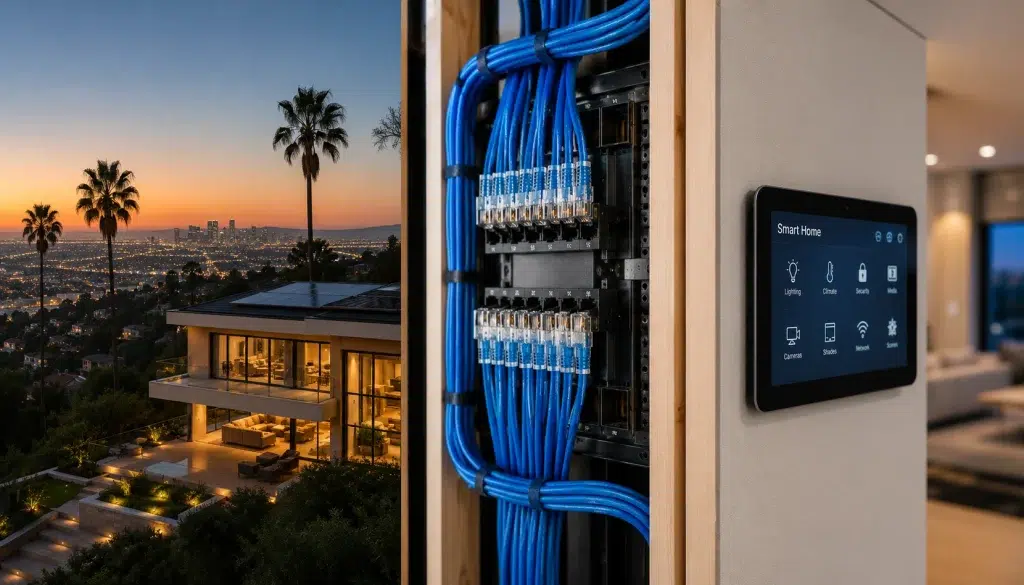
Structured cabling is the organized, centralized approach to low-voltage wiring. Instead of random cables run wherever there’s space, every run is home-run to a central network closet, labeled, and tested. Therefore, the home is easier to support and easier to upgrade.
Core elements of structured cabling in a new home
- Network closet / structured media area: the central termination point
- Patch panel: clean terminations for all Ethernet runs
- Switch: distributes network connections throughout the home
- Labeling: both ends of every cable are clearly identified
- Testing: runs are validated before drywall and at trim-out
- Documentation: an as-built map for future service
Why a network closet matters more than people think
A network closet is the “heart” of the home network. However, many new builds still treat it like a tiny box in a hot corner. Therefore, planning the closet properly prevents heat issues, messy installs, and upgrade limitations.
California smart home wiring: what to wire vs what to leave on WiFi
Smart homes work best when fixed devices are wired and mobile devices stay wireless. Therefore, the goal is a hybrid design that keeps WiFi fast and stable.
Best devices to wire in a smart home
- WiFi access points (wired backhaul)
- Smart TVs, streaming boxes, and game consoles
- Desktops and office docks
- Network video recorders (NVRs) and smart home hubs
- Security cameras (especially PoE)
Best devices to keep wireless
- Phones and tablets
- Guest devices
- Small IoT devices where wiring is not practical
Real-world scenario: A homeowner puts everything on WiFi, including TVs and a desktop. When the household is busy, video calls degrade and cameras lag. Wiring the TV and office drops reduces WiFi congestion immediately and improves the whole experience.
Expert Insight: If you want “fast WiFi,” wire the things that don’t move. That single decision improves performance more than most router upgrades.
New construction tech CA: the access point plan that makes WiFi predictable
WiFi coverage is rarely solved by one powerful router. Therefore, modern homes use multiple wired access points placed intentionally for coverage and capacity.
Access point planning checklist for new builds
- Plan at least one access point per floor
- Add more for long layouts, dense walls, or large open areas
- Prefer ceiling or high-wall locations for better signal spread
- Run Cat6 to each access point location (home-run to the closet)
- Plan for PoE so you don’t need outlets at access points
Outdoor and garage coverage (common California expectation)
- Plan a dedicated outdoor access point location if the home has a patio or yard
- Plan a garage access point if the garage is used as a gym, workshop, or EV charging zone
- Run Cat6 early so coverage is clean and stable
Structured cabling installation: quality rules that prevent “mystery problems”
Even the best plan can fail if the installation is sloppy. Therefore, structured cabling installation should include workmanship standards, labeling, and testing.
Structured cabling installation best practices
- Use home-run cabling to a central location (no daisy chaining)
- Avoid tight bends, kinks, and crushed cable
- Keep separation from electrical power where practical
- Use correct terminations and pinouts
- Protect cables at studs and penetrations
Cable labeling standards (simple and professional)
- Label both ends of every cable with the same ID
- Use a consistent naming format (Floor-Room-Wall-Port)
- Provide an as-built map that matches the labels
Cable certification testing (what “tested” should mean)
- Test every run before insulation and drywall
- Test again at trim-out
- Record results and keep them with homeowner documentation
Common Mistakes: Why smart homes feel unreliable
Mistake 1: No wired access point locations. This forces mesh nodes in bad spots and creates dead zones.
Mistake 2: Router placed where the ISP enters. Utility closets are convenient, but they are rarely the best WiFi location.
Mistake 3: Too few drops at TVs and offices. Fixed devices go wireless, WiFi gets congested, and performance feels inconsistent.
Mistake 4: No labeling or documentation. Troubleshooting becomes slow and expensive.
Mistake 5: Skipping testing. Bad terminations show up after move-in when fixes are hardest.
Best practices: a simple wired infrastructure scope for California new homes
Not every home needs the same number of drops. However, most successful projects follow a repeatable baseline. Therefore, use this as a practical starting point.
Baseline wiring plan (adjust based on layout)
- Access points: one wired access point per floor (plus extras as needed)
- TV locations: two Cat6 drops behind each TV
- Home office: two Cat6 drops at desk walls
- Bedrooms: at least one Cat6 drop per bedroom
- Cameras: Cat6 drops to planned exterior coverage points
- Garage: one Cat6 drop for future expansion
Industry standards (quick reference)
Professional installations follow proven standards and guidance. In addition, standards help ensure consistent performance and documentation.
- IEEE 802.3: Ethernet (wired networking)
- IEEE 802.11: WiFi (wireless networking)
- ANSI/TIA structured cabling standards: cabling performance and administration guidance
FAQ: wired infrastructure California new homes
Is wired infrastructure still worth it if WiFi is getting faster?
Yes. Faster WiFi does not eliminate interference, congestion, or coverage challenges. Wired infrastructure improves WiFi by enabling wired access points and wiring fixed devices.
What is the highest ROI wiring decision in a smart home?
Wiring access point locations. It makes WiFi predictable across the home and reduces the need for mesh workarounds.
Do I need to wire every room?
Not necessarily. However, wiring key zones (TVs, offices, access points, cameras) delivers most of the benefit while keeping the scope practical.
Should cameras be wired or wireless?
Wired cameras are typically more reliable and can use PoE. WiFi cameras can work, however they are more sensitive to congestion and coverage gaps.
What should I ask for at handoff?
Labeling, an as-built map, and testing results. In addition, confirm access point and camera locations before drywall so the final system is predictable.
Conclusion: California smart homes are raising the baseline for wiring
California’s smart home market is not slowing down. Homeowners want stable WiFi, reliable security, and work-from-home performance that feels effortless. However, those outcomes depend on the wiring plan. That’s why wired infrastructure California new homes is in higher demand, and why structured cabling California is becoming a standard expectation for new construction tech CA. When the home is wired for access points, offices, TVs, and cameras, the smart home becomes reliable, supportable, and ready for the next wave of devices.
Building a Smart Home in California? Wire It Right Before Drywall.
We’ll help you plan Cat6 drops, wired access points, and camera wiring so your new home has clean, labeled, tested infrastructure and predictable WiFi from day one.
Call: 833-469-6373 or 516-606-3774
Text: 516-606-3774 or 772-200-2600
Email: hello@unifinerds.com | Visit: unifinerds.com
Free consultations • Phased implementation • Budget-friendly • Expert support