

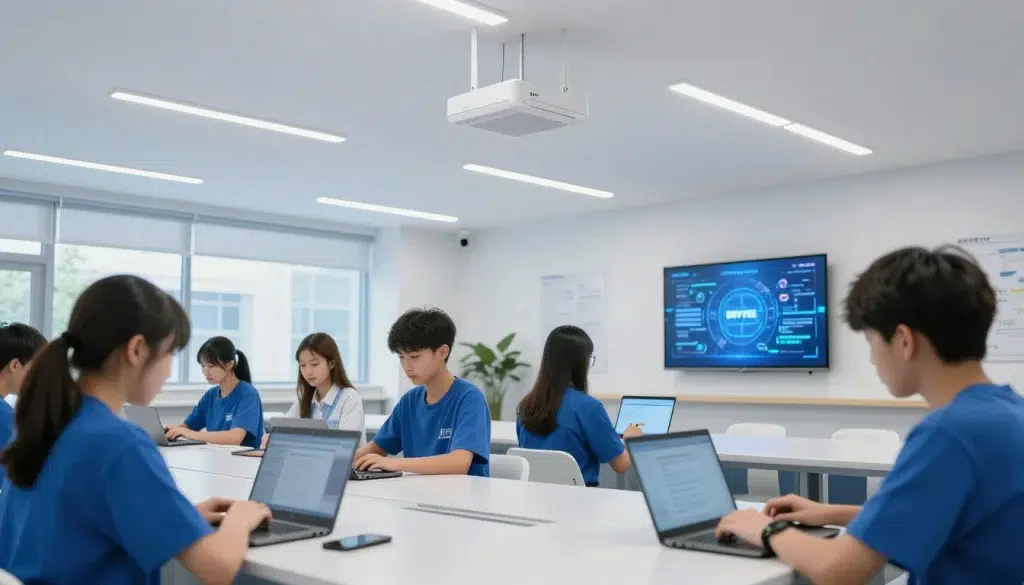
School WiFi Design: BYOD, Density Planning, and Safer Access
If your school WiFi slows to a crawl during first period, drops in certain classrooms, or turns into a daily help-desk fire drill when students bring new devices, you are not alone. A modern school wifi installation has to support byod wifi expectations, handle high density wifi schools usage patterns, deliver reliable classroom wifi, and apply practical content filtering without breaking learning apps. This guide explains a real-world approach to designing campus wireless that stays stable during peak usage and is safer for students and staff.
The goal is simple: consistent connectivity in classrooms, predictable performance in common areas, and security controls that reduce risk without creating constant login problems.
Why school WiFi is harder than office WiFi
Schools have unique traffic patterns. However, many networks are still designed like small offices. Therefore, they fail when hundreds or thousands of devices connect at the same time.
What makes high density WiFi schools challenging
- Peak concurrency: entire grade levels connect at once between bells.
- BYOD variety: phones, Chromebooks, tablets, laptops, and gaming devices.
- Video-heavy learning: streaming lessons, testing platforms, and collaboration tools.
- Older buildings: concrete, brick, metal, and thick walls block signal.
- Large campuses: multiple wings, portable classrooms, gyms, and outdoor areas.
Expert Insight: Most school WiFi failures are not “coverage” failures. They are capacity failures. You can have strong signal in every classroom and still have slow WiFi because the airwaves are overloaded. Density planning and channel reuse matter more than raw signal strength.
Start with a usage map: where learning happens and where devices pile up
Before you buy hardware, map real usage zones. Therefore, you design for learning workflows, not just floor plan symmetry.
High-priority areas for classroom WiFi planning
- Classrooms: consistent performance for instruction and testing
- Libraries/media centers: high dwell time and heavy usage
- Cafeterias: dense, noisy RF environment during lunch
- Gyms/auditoriums: assemblies and events create sudden spikes
- Admin offices: staff systems and sensitive data
- Outdoor courtyards: learning and events outside the building
Real-world scenario: A school reports “WiFi is fine in most classrooms, but testing fails in one wing.” The wing has older concrete walls and a high number of Chromebooks connecting at once. After adding capacity-focused AP placement and tuning channels for that wing, testing becomes stable without changing the ISP plan.
BYOD WiFi: design for unknown devices without losing control
BYOD wifi means you cannot assume every device is managed or safe. In addition, you need a way to keep student devices from impacting staff systems.
Practical network segmentation for schools
- Staff network: staff laptops, admin systems, printers (restricted access)
- Student network: student BYOD and school-issued devices (filtered and isolated)
- Guest network: visitors and events (internet-only)
- IoT network: projectors, smart boards, cameras, signage (restricted)
- Management network: network devices only (switches, APs, controllers)
What segmentation should accomplish
- Students cannot access staff devices or administrative systems.
- Guests cannot access internal resources.
- IoT devices are isolated so they cannot become a security risk.
- Testing platforms and learning tools remain reachable and stable.
Tips: Make BYOD support easier for IT teams
- Keep SSIDs minimal: Staff, Student, and Guest is often enough.
- Use clear naming so users self-select correctly (example: School-Student).
- Document “what goes where” for printers, projectors, and classroom devices.
High density WiFi schools: capacity planning that actually works
Capacity planning is about airtime. Therefore, the design must prevent too many devices from competing on the same channel.
What drives capacity needs in schools
- One-to-one device programs (Chromebooks, iPads)
- Video lessons and interactive content
- Online testing windows (high concurrency, high sensitivity)
- Assemblies and events (auditoriums, gyms)
Capacity best practices for classroom WiFi
- Use more APs where density is high: smaller cells often perform better.
- Plan channel reuse: neighboring APs should not fight each other.
- Control transmit power: avoid oversized cells that create sticky clients.
- Prioritize 5 GHz and 6 GHz (where supported): more capacity, less interference.
- Validate during real usage: test when students are present, not after-hours.
Expert Insight: In schools, the “fastest” network is often the one with the cleanest RF, not the most APs. If APs overlap too much, they compete and everyone slows down. Good channel planning and power tuning are what make density manageable.
Classroom WiFi design: what to do (and what to avoid)
Classrooms need consistent performance, not just coverage. However, many installs place APs based on convenience rather than learning needs.
Classroom WiFi best practices
- Place APs to serve the student seating area, not just the teacher desk.
- Avoid placing APs inside closets or behind large metal objects.
- Plan for adjacent classroom interference (especially in long hallways).
- Validate with the same device types students use (Chromebooks, tablets).
Special areas: libraries, cafeterias, gyms, and auditoriums
- Libraries: plan for high dwell time and steady load.
- Cafeterias: expect noisy RF and dense usage during lunch blocks.
- Gyms/auditoriums: plan for events and assemblies, not daily average.
Common Mistakes: Why school WiFi “looks strong” but performs poorly
Designing for coverage only. Strong signal does not guarantee performance under load.
Turning AP power to high everywhere. It increases interference and makes roaming worse.
Testing after-hours only. The network behaves differently when hundreds of devices connect.
Content filtering: safer access without breaking learning
Content filtering is often required for student safety and compliance. However, filtering that is too aggressive can break educational tools, video platforms, and testing systems. Therefore, filtering should be policy-driven and tested with real classroom workflows.
Content filtering best practices for schools
- Apply filtering by role: students vs staff vs guests should have different policies.
- Use allow-lists for learning tools: prevent “random blocks” during class.
- Log and review blocks: so you can fix false positives quickly.
- Plan for encrypted traffic: modern filtering needs clear policy and testing.
Real-world scenario: A school enables strict filtering and suddenly video lessons fail in multiple classrooms. The filter blocks a CDN domain used by the learning platform. After adding a targeted allow-list and validating with teachers, the issue disappears and safety controls remain intact.
Infrastructure matters: cabling, PoE, switching, and uptime
A school wifi installation is only as stable as the wired network behind it. In addition, PoE budgets and switch uplinks can quietly become bottlenecks.
Infrastructure checklist for reliable school WiFi
- Structured cabling: clean runs to each AP location, properly labeled.
- PoE switching: confirm PoE budgets match AP models and quantities.
- Uplinks between closets: size links for peak usage and testing windows.
- UPS protection: keep core network equipment online during brief outages.
- Documentation: AP maps, switch port maps, VLAN lists, and support notes.
Industry standards and guidance to reference
- IEEE 802.11: WiFi fundamentals, roaming behavior, and client compatibility
- ANSI/TIA structured cabling standards: cabling performance, labeling, and topology
- IEEE 802.3: Ethernet and PoE fundamentals for powering APs and devices
Best practices checklist: school wifi installation that stays stable during peak usage
- Map usage zones and design for peak concurrency, not average days.
- Segment networks: staff, students, guests, IoT, and management.
- Plan for high density WiFi schools with clean channel reuse and tuned power.
- Validate classroom WiFi with real student devices during real usage.
- Implement content filtering by role and test learning platforms end-to-end.
- Confirm PoE budgets, uplinks, and UPS protection for uptime.
- Deliver clear documentation for IT teams and future expansions.
FAQ: school WiFi installation, BYOD, and content filtering
How many access points does a school need?
It depends on building materials, classroom density, and device count. Schools often need more APs than expected because capacity is the real limiter. A survey-driven design and validation during peak usage is the best way to size AP count accurately.
What is the best way to support BYOD WiFi safely?
Use segmentation to separate student devices from staff systems, apply role-based policies, and isolate guests. BYOD works best when the network is designed for unknown devices and high concurrency from the start.
Why does WiFi fail during online testing?
Testing windows create high concurrency and higher sensitivity to latency and packet loss. Therefore, you need capacity planning, clean channel reuse, and validation under real conditions. Segmentation also helps protect testing traffic from guest or IoT noise.
Will content filtering slow down the network?
It can if it is implemented without proper sizing and policy design. However, role-based filtering with targeted allow-lists for learning tools can keep performance stable while improving safety.
Should staff and students share the same WiFi network?
No. Staff networks should be separated for security and stability. Student networks should be filtered and isolated as needed. This reduces risk and prevents student device issues from impacting staff operations.
Conclusion: school WiFi succeeds when it is designed for BYOD and peak density
A reliable school wifi installation is built for real school conditions: BYOD variety, bell schedule spikes, and high device density in classrooms and common areas. When you segment networks, plan for capacity, validate with real devices, and apply content filtering with tested policies, you get WiFi that supports learning instead of interrupting it.
If your campus is struggling with dead zones, slow speeds, or testing failures, start with a usage map and a survey-driven plan. That is the fastest path to predictable performance and safer access.
Need School WiFi That Handles BYOD, Testing, and Peak Density?
We’ll design a campus WiFi plan for classroom performance, secure segmentation, and safer student access—built to stay stable when the whole school connects at once.
Call: 833-469-6373 or 516-606-3774
Text: 516-606-3774 or 772-200-2600
Email: hello@unifinerds.com | Visit: unifinerds.com
Free consultations • Phased implementation • Budget-friendly • Expert support