
What Is Structured Wiring and Why Should NYC Homebuilders Care?
If you’re building or renovating a home in New York City, you already know one thing: once the walls close, everything gets harder and more expensive. That’s exactly why structured wiring NYC matters. A modern home wiring system NYC plan brings internet, WiFi, cameras, intercoms, and smart home tech together in a clean, organized way. In addition, professional low voltage wiring NYC planning helps NYC builders support today’s expectations for NYC new construction technology without relying on last-minute “WiFi fixes” after move-in.
Target audience: NYC homebuilders, general contractors, architects, and developers working on new construction or gut renovations (single-family, townhomes, and multi-unit residential) who want a future-proof, supportable technology plan.
What “structured wiring” actually means (in plain English)
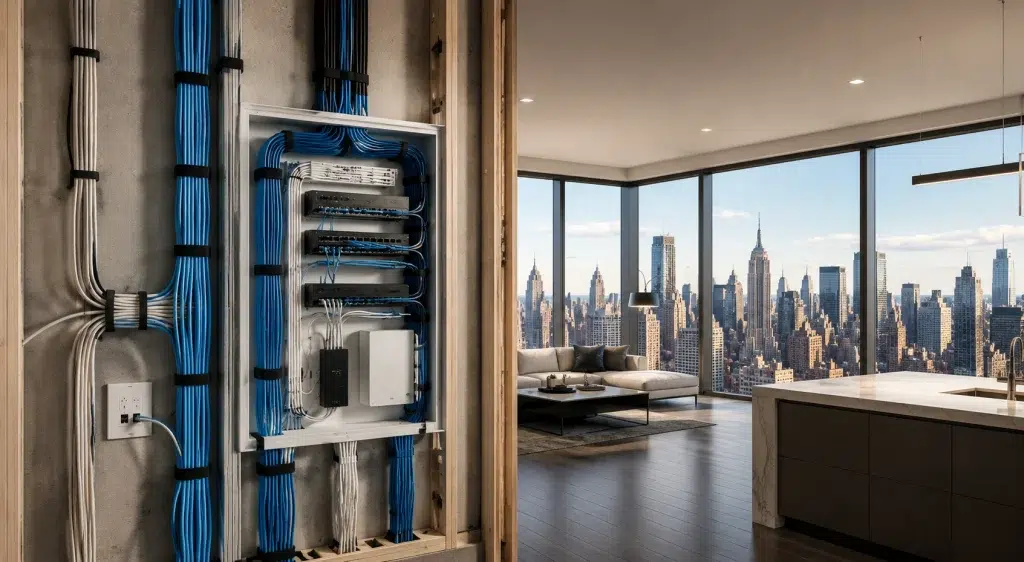
Structured wiring is a planned, centralized approach to low-voltage cabling in a home. Instead of random wires run wherever someone had space, everything is routed back to a dedicated location, often called a network closet or structured media panel.
What a structured wiring system includes
- Data cabling: typically Cat6 Ethernet for internet and network connections
- Coax cabling: sometimes used for cable TV or specific ISP requirements
- Fiber pathways: optional, but smart for future upgrades in certain builds
- Speaker wiring: for distributed audio (if the project includes it)
- Camera and doorbell wiring: often PoE (Power over Ethernet) capable
- Access point cabling: ceiling or high-wall drops for strong WiFi coverage
- Central termination: patch panels, structured panels, and labeled endpoints
Therefore, structured wiring is less about “more wires” and more about better planning, clean termination, and future-proof pathways.
Expert Insight: In NYC projects, the biggest win is not just speed. It’s supportability. When every cable is labeled, tested, and home-run to a central closet, troubleshooting becomes minutes instead of hours.
Why NYC homebuilders should care (even if the homeowner “just wants WiFi”)
NYC homes are tough on wireless networks. You have dense buildings, heavy construction materials, and unpredictable interference from neighboring units. Therefore, structured wiring becomes the foundation for reliable performance.
NYC realities that make structured wiring more important
- Concrete, brick, and steel: common in NYC construction and terrible for WiFi signal travel
- High RF congestion: dozens of nearby WiFi networks competing for airtime
- Mechanical rooms and utility closets: often where ISPs enter, but not where WiFi should originate
- Multi-floor layouts: townhomes and duplexes need planned access point placement
- Smart home demand: cameras, locks, intercoms, and automation are now standard expectations
Real-world scenario: A gut-renovated brownstone gets a “top-tier router” installed in the basement because that’s where the ISP line enters. The homeowner complains that the third floor is slow. The fix is not a bigger router. The fix is structured wiring with Cat6 runs to properly placed access points.
Structured wiring NYC: what to plan before drywall
Structured wiring is easiest when the framing is open. Therefore, the best time to plan is during design development and rough-in, not at trim-out.
Step-by-step: how to plan a home wiring system NYC builders can stand behind
Step 1: Choose the “home base” (network closet / structured panel)
Pick a location with power, ventilation, and space. In addition, it should be accessible for future service.
- Dedicated closet is ideal
- A utility area can work if it stays cool and has room to expand
- Avoid cramped, hot spaces with no airflow
Step 2: Map the home by “use zones,” not just rooms
Think about how the homeowner will live and work. Therefore, plan drops based on real usage.
- Home office zones (video calls, docking stations, printers)
- Media zones (TVs, streaming, gaming)
- Security zones (entry points, garage, common areas)
- WiFi zones (each floor, long hallways, large open areas)
Step 3: Decide what gets wired vs what stays wireless
Wired connections reduce WiFi congestion. In addition, they improve reliability for fixed devices.
- Wire TVs, desktops, access points, and cameras whenever possible
- Leave phones and tablets on WiFi
- Plan for PoE where it makes sense (access points, cameras, some doorbells)
Step 4: Run home-run cabling and label everything
Every cable should go back to the central location. Therefore, you avoid mystery splices and hidden junctions.
- Use consistent labeling on both ends
- Document drop locations and cable IDs
- Keep bends gentle and avoid crushing the cable
Step 5: Test before walls close
Testing early prevents expensive callbacks. Therefore, test each run at rough-in or before insulation and drywall.
Tips: Structured wiring decisions that save NYC projects
- Run at least one Cat6 drop to every planned WiFi access point location (ceiling is best).
- Put two Cat6 drops behind TVs and in home office areas, not one.
- Add conduit from the network closet to key areas for future upgrades.
- Plan the ISP entry point and the network closet as two separate concepts when needed.
- Require labeling and a simple as-built map before final payment.
Low voltage wiring NYC: what counts as “low voltage” in residential builds
Low voltage wiring covers the technology layer of the home. It is separate from electrical power wiring. However, it still needs planning, pathways, and quality control.
Common low-voltage systems in NYC new construction technology
- Internet and networking (Cat6)
- WiFi access points (wired backhaul)
- Security cameras and NVRs
- Video doorbells and intercom systems
- Access control and smart locks (depending on system)
- Distributed audio and home theater
- Smart shades and automation hubs
Therefore, structured wiring is the “skeleton” that lets these systems work without hacks and patchwork later.
Common mistakes NYC builders make with structured wiring (and why they happen)
Most wiring problems are not technical. They are planning problems. Therefore, the fix is a better process, not a better gadget.
Common Mistakes: Structured Wiring in NYC Homes
Mistake 1: Treating WiFi as the plan. WiFi is the finish layer, not the foundation. Without wired access point locations, coverage becomes guesswork.
Mistake 2: Putting everything in a tiny utility box. Modern networks need space for a router, switch, patch panel, and sometimes battery backup.
Mistake 3: Not planning for multi-floor coverage. NYC townhomes and duplexes need access points placed by design, not by convenience.
Mistake 4: No labeling or documentation. When something fails, nobody knows what cable goes where.
Mistake 5: Skipping testing. Bad terminations and damaged cable runs are common and expensive to fix after drywall.
Best practices for a home wiring system NYC homeowners will actually appreciate
Homeowners don’t usually ask for “structured wiring.” They ask for things that structured wiring enables. Therefore, focus on outcomes: stable WiFi, smooth streaming, and reliable security.
Best practices checklist
- Centralize all low-voltage terminations in a dedicated, accessible location
- Use Cat6 for data runs and wired backhaul to access points
- Plan access point locations per floor and per layout, not per budget guess
- Use patch panels or structured panels for clean terminations
- Label both ends of every cable and provide an as-built map
- Test every run before drywall and again at final trim
- Keep low-voltage separated from high-voltage to reduce interference risk
Expert Insight: The fastest way to lose time on an NYC build is to discover “tech problems” at the finish line. A simple structured wiring scope, plus labeling and testing, prevents most of the last-minute chaos.
Industry standards and guidance (what pros follow)
Structured wiring is not random. It is based on proven standards and best practices. In addition, standards help ensure consistent performance and documentation.
- ANSI/TIA structured cabling standards: guidance for cabling performance and administration
- IEEE 802.3: Ethernet standards for wired networking
- IEEE 802.11: WiFi standards for wireless networking
- NEC principles: safe routing and separation practices (as applicable to low-voltage pathways)
If you want a deeper dive, you can reference our guide on structured cabling installation best practices and our checklist for planning Ethernet drops for a new build.
FAQ: Structured wiring NYC
Is structured wiring only for luxury homes?
No. Structured wiring is about planning and organization. Even modest NYC builds benefit because it reduces callbacks and improves WiFi reliability.
How is structured wiring different from “just running a few Cat6 lines”?
Structured wiring includes a central termination point, labeling, documentation, and a plan for access points and future expansion. Therefore, it’s a system, not a handful of cables.
How many access points should a NYC home have?
It depends on layout, materials, and floors. However, many multi-floor NYC homes perform best with at least one wired access point per floor, plus additional units for long layouts or outdoor areas.
What is the biggest ROI item in structured wiring?
Wired access point locations. They make WiFi predictable and stable, especially in dense NYC environments with heavy construction materials.
Should builders provide documentation to homeowners?
Yes. A simple as-built map and labeled patch panel saves time for everyone later. In addition, it makes future upgrades easier and less invasive.
Conclusion: structured wiring is the “invisible upgrade” that prevents future headaches
NYC homeowners expect strong WiFi, reliable streaming, and smart home features that just work. However, those outcomes depend on what happens before drywall. Structured wiring NYC gives builders a repeatable, professional way to deliver modern NYC new construction technology without guesswork. When the home wiring system NYC is planned, labeled, and tested, the home is easier to support, easier to upgrade, and far less likely to generate last-minute punch list surprises.
Want a Clean, Builder-Friendly Structured Wiring Plan for NYC?
We’ll help you design low-voltage wiring, access point locations, and a labeled, tested structured wiring layout that supports modern NYC homes from day one.
Call: 833-469-6373 or 516-606-3774
Text: 516-606-3774 or 772-200-2600
Email: hello@unifinerds.com | Visit: unifinerds.com
Free consultations • Phased implementation • Budget-friendly • Expert support